
Signs a review might be fake
- You have no record of the customer, the job or the date.
- The reviewer’s profile has no photo, one or two reviews, or dozens of reviews in different cities on the same day.
- Several reviews arrive in a short burst, with similar wording.
- The review describes a product or service you don’t offer.
- It names a competitor as the better choice.
- The reviewer is a former employee or has another connection to the business.
None of these proves a review is fake on its own. Collect what you can: screenshots, dates, and what your booking records show.
How to report a fake review
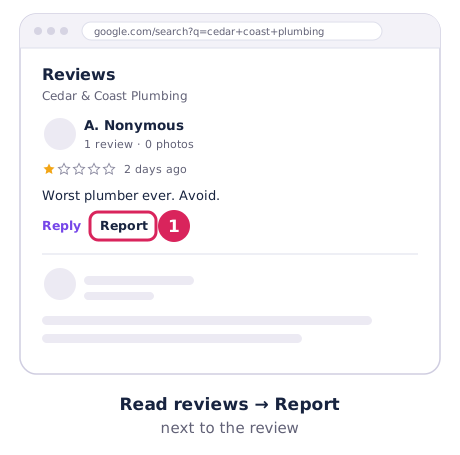
- Open your Business Profile, choose Read reviews, then Report next to the review.
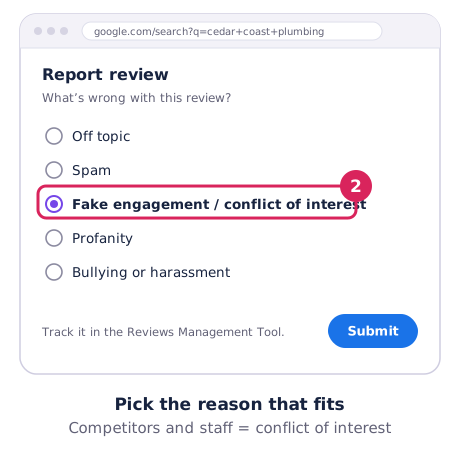
- Choose the reason that fits. Reviews from competitors, staff or anyone not based on a real experience fall under fake engagement / conflict of interest.
- Track it in Google’s Reviews Management Tool. If Google says no, you get one appeal. Include your evidence.
Fake positive reviews on a competitor’s profile can be reported the same way from Google Maps: three dots → Report review. More detail on what Google removes is in can you remove a Google review?.
What the ACCC says
Fake reviews are illegal in Australia, not just against Google’s rules. The ACCC’s guide Online reviews for products and services says businesses must not:
- Write fake reviews, or arrange for others to write them.
- Publish reviews from family, staff or people paid in some way without saying so.
- Suppress, edit or remove genuine negative reviews on their own website or platform.
- Offer incentives for reviews without clearly disclosing them. (On Google, don’t offer them at all: Google bans incentives even when disclosed.)
The ACCC has taken action against businesses for this. HealthEngine was ordered to pay A$2.9 million, partly for not publishing negative reviews, and Service Seeking paid A$600,000. Current maximum penalties are listed on the ACCC’s fines and penalties page.
What Google does to businesses with fake reviews
Google’s fake engagement policy says profiles caught with fake reviews can be blocked from getting new reviews for a time, have existing reviews hidden, and show a warning banner telling customers that fake reviews were removed. Google emails the owner first and allows an appeal.
That warning costs far more trust than a few extra stars could ever win. Buying reviews, or paying an agency that does, isn’t worth it.
If a competitor is targeting you
- Report each review and keep records of dates and screenshots.
- Reply calmly so customers see your side. See the “looks fake” templates in how to respond to Google reviews.
- Report it to the ACCC through its report an issue affecting your business page if there’s a clear pattern.
- For serious, targeted attacks, get legal advice. Our review removal guide covers where defamation law fits.
The honest way to outweigh fake reviews
Ask every real customer for a review, every time. It’s legal, it’s allowed by Google, and it works. Get your free review link and QR code, and use our reviews calculator to set a target.